

Your tech stack is a liability, not an asset, unless every tool earns its place through measurable ROI. Most professional operators are currently drowning in SaaS fatigue and need a rigorous STR tech stack audit to survive. You're likely paying for redundant features across three different platforms while your team still wastes hours on manual data entry between non-integrated tools. It's a quiet margin killer. If your guest communication lags because your software can't keep up, you aren't running a business; you're managing a digital mess.
We both know that scaling beyond your first ten properties requires precision, not more subscriptions. This guide provides the exact framework to identify operational bloat, eliminate software overhead, and optimize your ecosystem for maximum scalability. We're going to strip away the noise and focus on building automated workflows that actually function without constant human intervention. We'll move through the process of auditing your current tools, identifying integration gaps, and selecting the leanest path toward a high-performance operation. It's time to stop overpaying for friction and start building for growth.
Key Takeaways
- Identify and eliminate tech bloat by conducting a rigorous STR tech stack audit to reclaim lost margins and stop paying for redundant features.
- Establish your PMS as the central nervous system of your business and vet all third-party integrations using a strict API stress test.
- Apply the Operational ROI metric to ensure every piece of software in your ecosystem saves more labor hours than it costs in monthly fees.
- Follow a systematic five-step inventory and usage mapping process to strip away unused features that create operational friction.
- Transition from generic software setups to a custom, AI-powered framework designed specifically for scaling beyond 10 properties.
The Profitability Drain: Why Most STR Operators Underutilize Their Technology
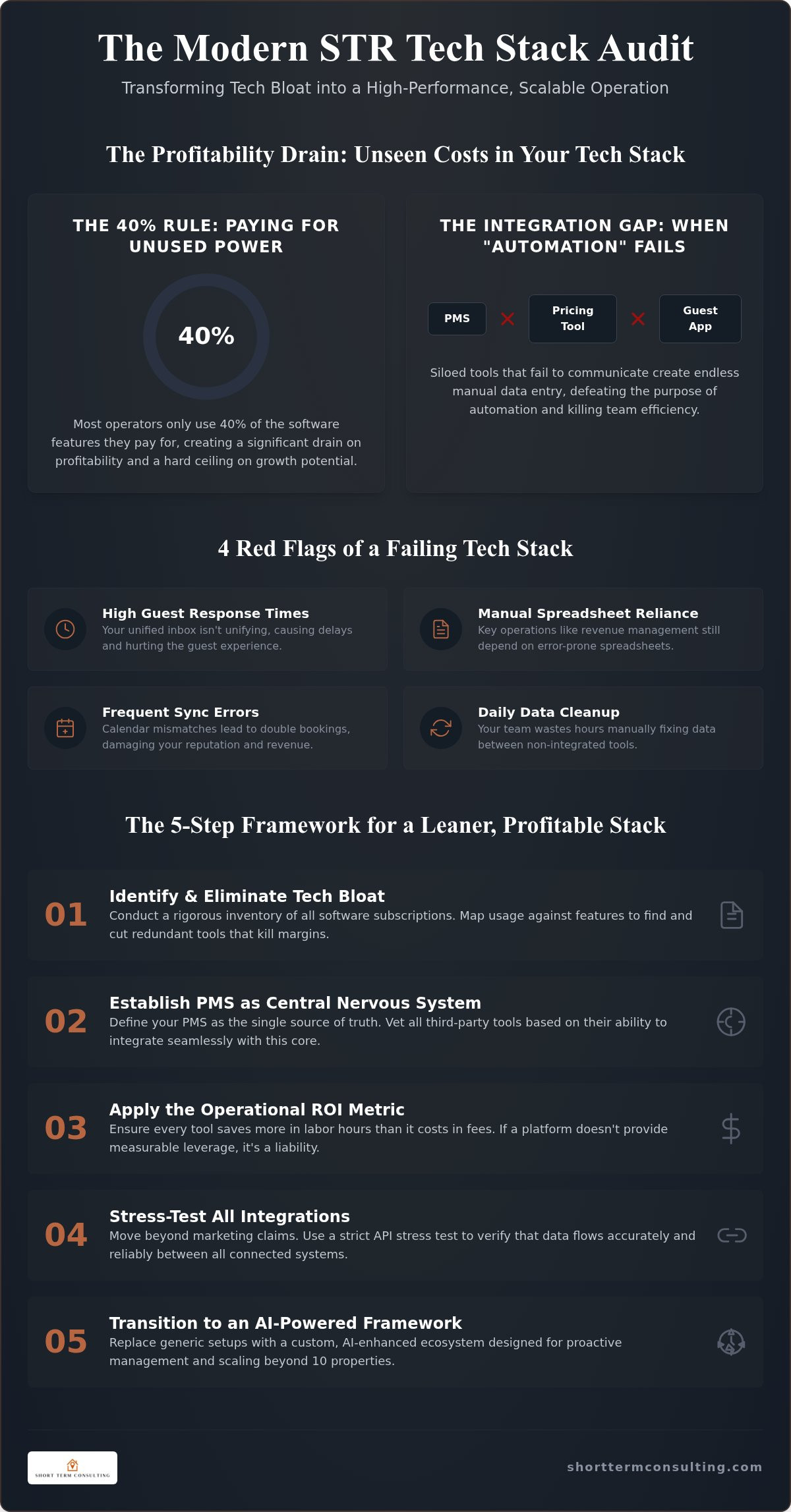
Software is supposed to provide leverage. For many professional operators, it's actually a silent leak in the P&L. A rigorous STR tech stack audit isn't just a spring cleaning of your apps. It's a systematic, high-stakes review of software ROI and operational fit. Most managers suffer from Tech Bloat. This is the accumulation of redundant SaaS subscriptions that slowly erode your margins. Each $100 monthly fee feels small; together, they kill your profitability.
The real failure isn't the tools themselves. It's the Integration Gap. You have a PMS, a dynamic pricing tool, and a guest guide, but they exist in silos. When data fails to move seamlessly between them, you pay for tools that don't actually talk to each other. This fragmentation is a major hurdle in the evolution of Property technology (PropTech). You end up with "automated" stacks that require constant manual intervention to stay synced. If you're still copy-pasting data between windows, your automation is a lie.
The 40% Rule and the Cost of Inaction
Industry data suggests many operators stop learning their software immediately after the initial onboarding. They typically use only 40% of the features they pay for. You're likely paying for "Pro" tiers while your team remains stuck on "Basic" workflows. This isn't just a waste of money. It's a ceiling on your growth. Tech friction leads to staff burnout as they fight the software rather than using it to scale. Eventually, it hits the guest. Lagging response times and missed booking details aren't software errors; they're symptoms of a neglected stack.
Identifying the Symptoms of a Broken Tech Stack
If you aren't sure if your current ecosystem is failing, look for these operational red flags. They indicate a desperate need for a rebuild:
- High guest response times despite having a supposedly unified inbox.
- Heavy reliance on manual spreadsheets for revenue management or owner reporting.
- Frequent calendar sync errors leading to the nightmare of double bookings.
- Employees spending more than an hour a day on data cleanup between non-integrated tools.
Manual workarounds are a tax on your time. Every minute spent fixing a sync error is a minute not spent on portfolio expansion. When you ignore these symptoms, you don't just lose money on software; you lose the ability to scale without adding more headcount.
The Architecture of Excellence: Mapping Your Short Term Rental Technology Stack
Excellence starts with a blueprint. You can't just bolt tools together and expect a streamlined operation. A professional STR tech stack audit treats your software as a unified ecosystem where every component has a specific, non-negotiable function. Just as enterprise firms prioritize information security audits to protect their digital infrastructure, you must audit your stack to protect your operational margins.
Your Property Management System (PMS) is the central nervous system of this architecture. It holds the core data, but it shouldn't necessarily attempt to do everything. You must decide on a philosophy: the "All-in-One" solution or the "Best-in-Breed" stack. All-in-one tools offer simplicity and a single bill. Best-in-breed stacks utilize specialized plugins for revenue management, guest experience, and field operations. The right choice depends entirely on your specific scale and growth goals.
The Core Pillars: PMS, Pricing, and Operations
Evaluate your PMS with total objectivity. Is it a bridge to growth or a bottleneck? A legacy PMS that lacks open API access will eventually stall your expansion. It must integrate flawlessly with a dedicated dynamic pricing engine. Static pricing is a relic of the past; modern engines analyze hyper-local market data to adjust your rates daily. This ensures you're never the cheapest property on the block during a peak event. If you're struggling to determine if your core tools are still fit for purpose, seeking professional advisory services can provide a clear roadmap for your next move.
The Specialized Layer: AI, Noise Monitoring, and Smart Access
The specialized layer is where you win back your time and eliminate friction. AI-powered communication is now a mandatory layer for professional PMCs. AI agents can resolve 80% of routine guest inquiries without your team lifting a finger. This allows your staff to focus on high-value hospitality tasks rather than repetitive FAQs about Wi-Fi passwords or check-in procedures.
Hardware-software integration is another critical ROI driver. Smart locks and thermostats should connect directly to your PMS. This automates the generation of unique access codes and allows for remote climate control between stays. When combined with specialized cleaning and maintenance software, you create a self-correcting operation. These tools ensure that tasks are assigned, tracked, and verified without constant human supervision. A high-performance stack is about building a system that works while you're focused on the next acquisition.
The STC Audit Framework: Evaluating ROI, Integration, and Scalability
Generic checklists aren't enough for professional operators. You need a rigorous framework that treats software as a financial instrument. The core of any STR tech stack audit is the Operational ROI metric. It's a simple calculation: does this tool save more labor hours than it costs in monthly subscriptions? To truly transform AI investments and software spend into profit, you must move beyond adoption and focus on measurable time recovery. If a tool costs $200 but saves five hours of a manager's time, it's a win. If it adds ten minutes of manual data entry per booking, it's a liability that will scale poorly.
Scalability is the next major hurdle. A stack that works for five properties often shatters at fifty. You must conduct an API Stress Test to evaluate the depth of data sharing between your PMS and third-party apps. This determines if your systems can handle increased volume without manual intervention. If your team ignores automated features and sticks to manual workarounds, you have a user adoption failure. A tool that isn't used is just a donation to a SaaS founder's bank account. Efficiency requires both technical capability and total team compliance to the system.
The Three-Tier Audit Methodology
A comprehensive STR tech stack audit requires a three-pronged approach. Start with a Financial Audit to review every subscription and your total per-unit cost. Perform a Functional Audit by mapping software features to specific SOPs. Finally, execute a Technical Audit. Check for latency, API failures, and data siloing that force your team into manual bridge tasks. This ensures your infrastructure is lean, functional, and ready for portfolio expansion.
Integration Health: Beyond the "Checkmark"
Don't trust a marketing checkmark that says "integrates with." There is a massive difference between a native integration and a fragile, Zapier-reliant workflow. Look for data leakage between your PMS and accounting software. For professional PMCs, Deep Integration is a non-negotiable standard where data flows bi-directionally in real-time without human intervention. Anything less is just a digital band-aid that will eventually fail under pressure as your booking volume increases.
Five Steps to a Leaner Stack: Executing Your Vacation Rental Software Audit
Execution is where most operators fail. They plan but don't pull the trigger. A successful STR tech stack audit requires a clinical, unsentimental approach to your digital inventory. Start by documenting every single subscription, its monthly cost, and its primary user. Most operators find at least two tools performing the same function. If you have a PMS with built-in messaging but still pay for a third-party guest comms app, you're likely leaking cash. Map every feature to a daily task. If a feature isn't touched in 30 days, it's dead weight that needs to be cut.
Interview your team to find the "tech pain." This pain usually exists where they have to manually bridge two non-integrated systems. Identify these friction points and move toward "The Great Trim." Consolidate specialized point solutions into your PMS’s native features whenever the functionality meets your core SOP requirements. If you're struggling to identify which tools to keep and which to kill, a professional tech stack audit can provide the objective roadmap you need to scale without the bloat.
Trimming the Fat: How to Cut Redundant Subscriptions
Use a "Zombie App" checklist to spot tools you forgot to cancel after a trial or a previous manager's tenure. Check your credit card statements against your software inventory. Use your audit data as leverage when negotiating with core vendors. If you're scaling, use your unit count to demand enterprise pricing. Stop paying retail for SaaS when you have the volume to negotiate a better deal. Consolidate your stack until every remaining tool is essential, integrated, and high-performing.
AI-First Reconfiguration
Transition to an AI-first model to reclaim your team's time. Replace low-level virtual assistants with AI guest communication frameworks that handle the repetitive noise of check-in instructions and Wi-Fi troubleshooting. This isn't just about saving money; it's about response speed. You should implement AI response time benchmarks where 95% of inquiries receive a high-quality resolution in under two minutes. Shift your human staff to high-value tasks like automating owner reporting. This single move can save your management team 10 or more hours every month. You aren't just cutting costs. You're buying back your leadership capacity.
Strategic Advisory: Scaling Your Portfolio with Short Term Consulting
Scaling from 1 to 10+ properties requires more than just adding listings. It requires a complete overhaul of your operational infrastructure. Short Term Consulting doesn't offer generic checklists or one-size-fits-all frameworks. We provide custom roadmaps built on 20 years of hands-on operator experience. A professional STR tech stack audit is the diagnostic tool we use to strip away inefficiency and prepare your portfolio for aggressive growth. We've seen every software failure in the book; we know which tools are load-bearing and which are just marketing fluff.
Technology and SOPs are inseparable. A tool is only as good as the process it supports. We bridge this gap by developing robust SOPs alongside your technology integration. This ensures that when you add a new property, your system absorbs it without increasing your team's stress levels. We focus on building a machine that runs itself, allowing you to focus on acquisition rather than troubleshooting sync errors. This audit is the first step in a broader portfolio growth strategy designed for elite managers.
Custom Frameworks vs. Generic Templates
The term "Best-in-Breed" is a moving target. What works for a high-turnover urban portfolio won't work for a luxury mountain retreat. We analyze your specific market dynamics and portfolio type to select the exact tools you need. Our approach to AI integration is particularly aggressive. We deploy AI guest communication frameworks designed to reduce manual response times by 80%. This isn't a theoretical improvement. It's a battle-tested strategy that has transformed complex operations into lean, high-margin businesses. We turn your technology from a cost center into a competitive advantage.
The Vendor Advantage: GTM Strategy for PropTech
Our expertise extends beyond property managers to the PropTech vendors themselves. Many software companies build features that sound good in a boardroom but fail on the front lines of the industry. STC provides a Go-To-Market and partnership strategy that bridges the gap between software developers and the professional operators they serve. We help vendors audit their own technology to ensure it meets the brutal realities of day-to-day property management. This unique perspective allows us to vet tools with a level of depth that generic consulting firms simply cannot match.
If you're ready to stop guessing and start scaling, it's time for a professional intervention. Your technology should be your greatest asset, not your biggest headache. Book a Tech Stack Audit with Short Term Consulting to begin your operational transformation and reclaim your margins today.
Future-Proof Your Operational Infrastructure
Stop treating your software as a collection of unavoidable monthly bills. It's time to treat it as a high-performance engine. You've identified how tech bloat kills margins and why deep integration is the only path to true scalability. A rigorous STR tech stack audit is the prerequisite for any operator looking to move beyond the plateau of manual workarounds. You need a system that functions autonomously so you can focus on high-level acquisition and market strategy.
Short Term Consulting brings 20+ years of operator-led industry expertise to your specific business challenges. We reject generic templates in favor of AI-powered operational frameworks and tailored strategies for PMCs, investors, and vendors. We ensure every tool in your stack earns its place through measurable ROI. Don't let operational friction or redundant SaaS fees hold your portfolio back from its full potential.
Maximize your operational efficiency; schedule your STC Tech Stack Audit today.
Your path to a leaner, more profitable operation starts with a single decisive action. Build the scalable foundation your business deserves.
Frequently Asked Questions
What is an STR tech stack audit?
An STR tech stack audit is a systematic evaluation of your software ecosystem to identify redundant tools, integration gaps, and measurable ROI. It moves beyond a simple inventory to analyze how well your property management system and third-party plugins support your specific SOPs. The goal is to eliminate tech bloat and ensure every subscription contributes to operational efficiency or margin growth for your professional management business.
How often should a property manager audit their software?
Perform a full audit annually to catch zombie subscriptions and evaluate new market-leading technologies. However, high-growth portfolios scaling past 10 units should conduct a review every six months. The PropTech landscape shifts rapidly. A tool that worked at five properties often becomes a bottleneck at twenty. Regular audits ensure your infrastructure stays ahead of your operational complexity as you expand your portfolio.
Will a tech stack audit help me reduce guest response times?
Yes, by identifying bottlenecks in your communication layer and implementing AI-powered frameworks. A proper audit evaluates the lag between guest inquiries and automated or manual replies. By streamlining your unified inbox and integrating AI agents, you can often reduce response times by 80% or more. This prevents guest dissatisfaction and improves your ranking on major booking platforms like Airbnb and VRBO.
Can I perform a vacation rental software audit myself?
You can document your tools and costs, but a professional audit requires deep industry benchmarking and technical expertise. Internal teams often suffer from sunk cost bias and struggle to see where current workflows are failing. Professional consultants bring 20 years of operator experience to objectively vet your stack. They identify deep integration issues that an internal team might overlook during a manual review process.
How do I know if I have too many tools in my STR tech stack?
The primary red flag is manual bridging, where staff copy-paste data between tools that should be integrated. If you pay for multiple platforms with overlapping features, such as two different guest messaging apps, you have tech bloat. Another sign is software fatigue among your team. If your staff avoids using specific tools because they're too complex, those tools are liabilities, not assets for your business.
What is the most expensive mistake in an STR tech stack?
The most expensive mistake is sticking with a legacy PMS that lacks an open API or deep integrations. This forces you to add expensive manual labor to compensate for software failures. You end up paying shadow costs in the form of employee hours spent fixing sync errors or double bookings. Over time, these labor costs far exceed the price of a more modern, integrated software solution.
Should I choose an all-in-one PMS or a best-in-breed stack?
It depends on your scale and specific market needs. All-in-one solutions offer simplicity and lower initial overhead for smaller portfolios. Best-in-breed stacks allow elite operators to pick the absolute best tool for pricing, guest communication, and maintenance. If you plan to scale beyond 20 units, a best-in-breed approach usually provides the flexibility and performance needed to maintain high margins and operational control.
How does AI change the way I should audit my technology?
AI shifts the focus from simple automation to intelligent task resolution. When you conduct an STR tech stack audit, you must evaluate if your current tools can support AI-powered guest communication and automated owner reporting. Older systems that don't support real-time data flow for AI agents are now obsolete. Your audit should prioritize tools that enable an AI-first operational framework to maximize your team's efficiency.

