

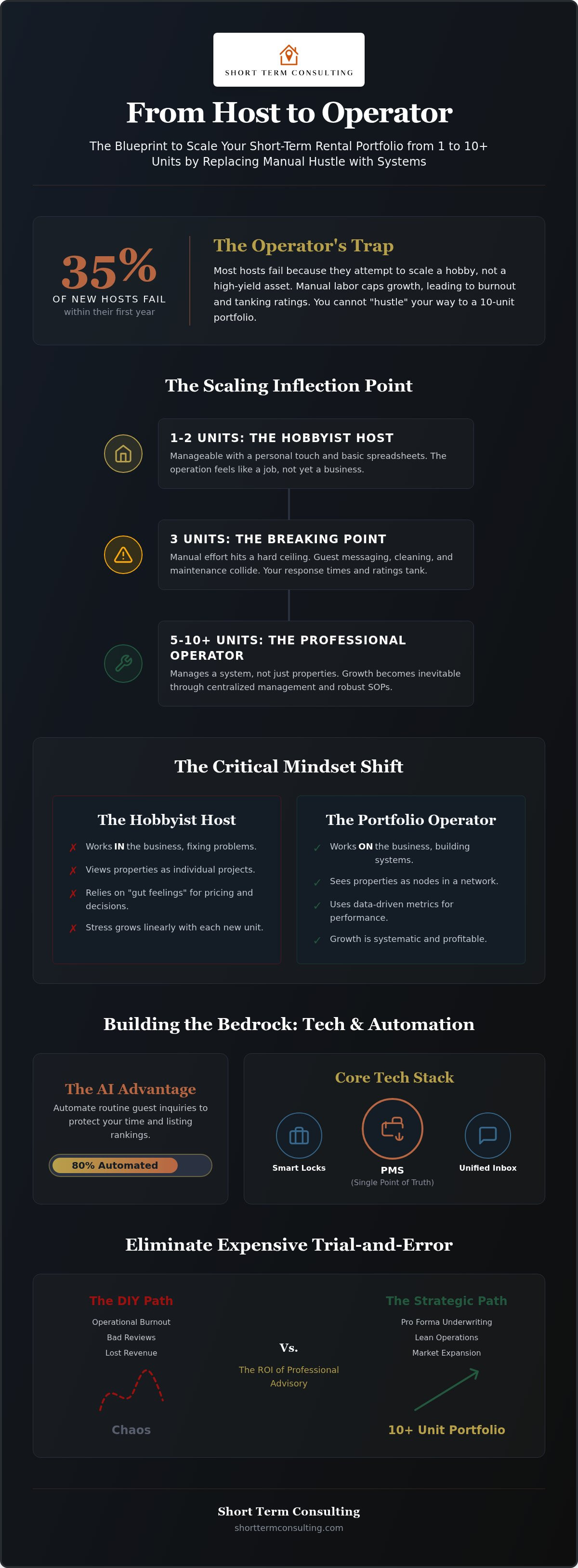
About 35% of new Airbnb hosts fail within their first year because they attempt to scale a hobby rather than a high-yield asset. If you're managing one property, you likely feel the weight of every guest message and turnover. It's the classic operator's trap. You want to expand, but your manual workflow won't survive the pressure of a multi-unit portfolio. Understanding how to grow from 1 to 10 Airbnbs requires a fundamental shift from hands-on hosting to system-based management.
You already know that the "hustle" doesn't scale. This article provides the professional roadmap to transition from a stressed host to a scalable short-term rental operator. You'll learn to deploy battle-tested SOPs and AI-driven growth strategies that remove you from the daily operational grind. We're moving past gut feelings. We're moving into data-backed market expansion and automated communication. This is your blueprint for a 10-unit portfolio that generates passive income through precision and elite execution.
Key Takeaways
- Identify the "Operator's Trap" where manual labor caps your growth. Learn why systems are the only path to a high-yield portfolio.
- Audit your tech stack. Implement standardized SOPs to ensure operations remain lean and profitable at scale.
- Master how to grow from 1 to 10 Airbnbs. Replace subjective market choices with rigorous pro forma underwriting.
- Automate up to 80% of routine guest inquiries. Integrate AI-powered communication to protect your time and listing rankings.
- Evaluate the ROI of professional advisory. Eliminate the expensive trial-and-error phase of portfolio expansion.
The Operator’s Inflection Point: Why the Jump to 10 Units Breaks Most Hosts
Hosting one unit is a job. Hosting ten is a business. Most people fail because they try to scale the job. This is the "Operator’s Trap." It’s the moment your manual effort hits a hard ceiling. You only have 24 hours. When guest messaging, cleaning coordination, and maintenance for multiple properties collide, your response times tank. Your ratings follow. You cannot "hustle" your way through a 10-unit portfolio.
The "Hobbyist Host" manages 1 or 2 units with a personal touch and a basic spreadsheet. It’s manageable. But at 3 units, you hit the breaking point. This is where the complexity of understanding the short-term rental market shifts from hospitality to logistics. A professional operator with 5 or more units doesn't "host" in the traditional sense. They manage a system. If you want to know how to grow from 1 to 10 Airbnbs, you must stop working in the business and start working on the business.
The Linear vs. Exponential Growth Problem
Scaling shouldn't be a linear increase in stress. If 10 units require 10 times the effort of one, your model is broken. Un-systemized growth leads to operational burnout. You miss a cleaning. A guest waits outside for a code. These aren't just mistakes; they're symptoms of a manual workflow. The inflection point is the exact moment where your manual hosting habits begin to cannibalize your profit and sanity.
Portfolio Mindset: Thinking in Systems, Not Rooms
Stop looking at properties as individual projects. Start looking at them as nodes in a network. A portfolio mindset replaces property-specific fixes with portfolio-wide protocols. Whether a unit is in a different zip code or a different state, the guest experience must be identical. Quality control doesn't happen by chance. It happens through centralized management and standardized operating procedures (SOPs). You need a tech stack that monitors performance across the board, not just unit by unit.
Operational excellence at scale requires three core shifts:
- Centralized Communication: One dashboard for all guest interactions.
- Vendor Accountability: Automated scheduling for cleaners and maintenance.
- Data-Driven Decisions: Using performance metrics rather than "gut feelings" to adjust pricing.
Moving from 1 to 10 units is a test of your systems, not your stamina. If the system is weak, the jump will break you. If the system is robust, the growth is inevitable.
Building the Bedrock: Scalable SOPs and the Tech Stack Audit
Standard Operating Procedures (SOPs) are the DNA of your business. Without them, you don't own a company; you own a series of fires that require your constant attention. If you want to master how to grow from 1 to 10 Airbnbs, you must stop being the "fixer" and start being the architect. This begins with a rigorous tech stack audit. Every piece of software in your ecosystem must justify its existence through measurable ROI, not just flashy features. If a tool doesn't save you time or increase your revenue per available room (RevPAR), cut it.
Your Property Management System (PMS) is the single point of truth for your entire operation. It's the central nervous system that coordinates bookings, pricing, and guest data. A professional operator uses a PMS to automate turnover management, ensuring cleaners are notified the moment a guest checks out. This eliminates the "no-show" cleaner risk that plagues hobbyist hosts. Implementing these systems is essential for strategic expansion for your business as you move toward institutional-grade management.
The Core Tech Stack for a 10-Unit Portfolio
At 10 units, you cannot afford to log into individual OTA apps. You need a PMS with robust API integrations, not just basic channel managers that rely on buggy iCal syncing. A unified inbox is non-negotiable. It pulls messages from Airbnb, Vrbo, and direct booking sites into one screen. Your hardware must also talk to your software. Integrate smart locks, noise monitors, and thermostats directly into your PMS to automate access codes and climate control based on occupancy status.
Developing SOPs That Actually Get Followed
Ditch the 50-page text manuals. Nobody reads them. Use the "Visual SOP" approach. Create short video clips and photo-based checklists for your cleaning and maintenance crews. This ensures a consistent "brand standard" across multiple zip codes. You also need clear emergency protocols for when things go wrong. If a pipe bursts or the WiFi fails, the system should dictate the response, not your personal stress levels. For a deeper dive into systemization, see our guide on Building Scalable SOPs: The Bedrock of STR Operations.
Professionalizing your backend is the only way to scale without sacrificing your quality of life. If your current systems feel like they're held together by duct tape, it's time for a change. You can start by requesting a professional tech stack audit to identify the friction points in your current workflow.
Market Selection and Pro Forma Underwriting
Amateurs buy where they want to vacation. Professionals buy where the numbers dictate. If you want to know how to grow from 1 to 10 Airbnbs, you must abandon the "I like this city" mentality. You need a cold, analytical framework. Every potential acquisition must pass through a rigorous underwriting process before you sign a lease or a mortgage. This is about identifying pockets of under-housed demand, not following the crowd to oversaturated tourist traps.
Expanding within a single market allows for operational efficiency. You share cleaning crews and maintenance staff. However, it exposes you to localized regulatory risk. Diversifying across markets mitigates that risk but increases logistical complexity. Finding the right balance requires a deep understanding of STR Market Selection & Pro Forma Underwriting to ensure every new unit adds to your bottom line without overextending your resources.
Hard Data Over Gut Feeling
Stop guessing. Start tracking. RevPAR (Revenue Per Available Room) is the only metric that truly matters for your yield analysis. In 2026, the U.S. average occupancy rate sits between 50% and 57.4%. If your pro forma assumes 80% to make the numbers work, you aren't investing; you're gambling. Pro Forma underwriting is the elimination of investment guesswork by modeling every possible financial outcome. Use market analyzer tools to compare your potential ADR against current national averages, which hover between $246 and $259. If the spread isn't there, walk away.
Acquisition Strategy: Rental Arbitrage vs. Ownership
Scaling to 10 units quickly often requires a mix of strategies. Rental arbitrage offers a lower barrier to entry. It allows you to deploy capital into furnishings rather than down payments. But it lacks long-term equity. Ownership builds wealth but slows the pace of expansion. When pitching landlords for arbitrage, position yourself as the "Professional Operator." You offer 24/7 monitoring, professional cleaning, and guaranteed rent. You aren't a tenant; you're a commercial partner.
Always assess regulatory volatility. States like Idaho and Indiana have passed host-friendly laws, while cities like New York remain restrictive. Your roadmap must prioritize markets with stable, predictable legislation. If you're purchasing, factor in current 30-year fixed mortgage rates, which averaged 6.69% in August 2026. High interest rates demand even tighter underwriting to maintain your cash-on-cash return targets.
The AI Advantage: Automating the Guest Journey
The 24/7 guest expectation is no longer a luxury; it’s the baseline. If you’re still typing manual replies at 2 AM, you’ve hit a scalability wall. Manual messaging kills your sleep and, eventually, your search ranking. Airbnb’s algorithm prioritizes fast response times. When you’re figuring out how to grow from 1 to 10 Airbnbs, you cannot afford to be the bottleneck. You must implement AI-powered communication to handle 80% of routine inquiries. We are moving beyond basic "auto-responders." You need intelligent, context-aware AI agents that understand the difference between a late checkout request and a genuine maintenance emergency.
AI Integration Step-by-Step
Start by mapping the guest journey from the initial inquiry through to the post-checkout review. Every touchpoint is an opportunity for automation. Set strict "guardrails" for your AI. The system should handle parking instructions, WiFi codes, and check-in procedures without human intervention. However, the AI must transition the conversation to a human operator the moment a guest reports a physical issue or a negative experience. This hybrid model allows you to reduce response times to under five minutes without hiring a fleet of virtual assistants. It ensures your listings stay at the top of search results while you focus on acquisition. For a deeper look at this process, see our guide on Reducing Guest Response Time via AI Integration.
Revenue Optimization via Intelligent Pricing
"Set it and forget it" pricing is a recipe for mediocrity. You’re likely leaving 20% of your potential revenue on the table if you aren't using dynamic pricing. True dynamic pricing is not just about seasonal adjustments. It’s an algorithm that reacts in real-time to local events, lead times, and orphan nights. If a major festival is announced for next month, your prices should spike instantly. If you have a two-night gap between bookings, the system should automatically discount it to capture "orphan night" revenue. This level of precision is how professional operators maintain high yields even when market occupancy fluctuates. Scaling a portfolio requires this shift from human-centric to tech-centric operations. If you want to master how to grow from 1 to 10 Airbnbs, you must leverage AI to protect your time and your margins.
Elite operators don't guess their way to growth. They build engines that work while they sleep. You can start refining your own engine by requesting an AI-Powered Guest Communication Strategy audit to see where your manual habits are costing you money.
Strategic Advisory: The ROI of Professional Guidance
Stop DIYing your growth. You’ve reached the limit of what manual effort and basic tutorials can achieve. Learning as you go is the most expensive way to build a business. You pay for that education in lost bookings, negative reviews, and operational burnout. Short Term Consulting helps operators bridge the 1-to-10 gap by replacing trial and error with 20+ years of hands-on experience. We don't deal in theory. We deliver functional, scalable outcomes that turn a collection of properties into a high-performance asset.
Understanding how to grow from 1 to 10 Airbnbs requires more than just adding listings. It requires a fundamental shift in your role from host to executive. This transition is where most operators fail. They lack a battle-tested roadmap. A strategic advisor provides the objective perspective needed to identify the friction points you’re too close to see. We help you build a business that works for you, rather than a job that owns you.
Custom Roadmaps vs. Generic Frameworks
Generic advice fails because it ignores your specific context. Your market, property type, and target demographic dictate your tech stack requirements. A mountain cabin has different maintenance and guest communication needs than an urban studio. A professional Tech Stack Audit identifies exactly where your current software is leaking cash or creating unnecessary work. This isn't just about reaching 10 units. It’s about building the infrastructure that supports the eventual jump to 50 units. We focus on Property Management SOP Development that ensures your brand standards remain consistent regardless of your portfolio size.
Ready to Scale?
Review your current bottlenecks today. If guest messaging or turnover coordination still requires your personal attention, you aren't ready to scale. The most common objection to professional advisory is the perceived cost. Operators say "scaling is expensive." The reality is that inefficient scaling is expensive. Professional automation makes expansion profitable. It allows you to increase your unit count without a proportional increase in overhead or stress. A 10-unit portfolio is a serious business. Treat it like one. If you're ready to stop guessing and start growing, schedule a portfolio scaling consultation with Short Term Consulting. We’ll help you implement the systems required for elite execution and sustainable growth.
Build Your 10-Unit Engine
Scaling is a logistics game. You've seen why the jump to 10 units breaks most hosts. It isn't a lack of effort; it's a lack of infrastructure. By implementing scalable SOPs and data-driven underwriting, you move from a stressed hobbyist to a professional operator. Mastering how to grow from 1 to 10 Airbnbs requires you to let AI handle the routine while you focus on high-level acquisition. You don't need more hours. You need better systems.
Don't waste capital on trial and error. Short Term Consulting provides the elite expertise required to secure your portfolio's future. We leverage over 20 years of hands-on experience and AI-powered operational frameworks to build customized roadmaps for serious investors. It's time to stop working for your properties and start making them work for you. The transition from operator to executive starts with a single strategic decision.
Scale your portfolio with a professional STR strategy audit and eliminate the friction in your growth. Your 10-unit portfolio is within reach. Build it with precision.
Frequently Asked Questions
How many properties can one person manage before needing help?
One person can typically manage 3 to 5 properties before operational friction begins to erode the guest experience. Beyond this threshold, you enter the "Operator’s Trap" where manual labor caps your growth potential. Learning how to grow from 1 to 10 Airbnbs requires shifting from manual hosting to system-based management. By implementing automated scheduling and centralized communication, a single operator can oversee 10 units efficiently without sacrificing quality or sanity.
What is the best software for managing multiple Airbnbs?
The best software depends on your specific portfolio, but you need a Property Management System (PMS) with robust API integrations rather than basic iCal syncing. A professional tech stack usually includes a PMS, dynamic pricing tools, and AI communication agents. Short Term Consulting provides tech stack audits to help you select tools that offer the highest ROI for your market. Avoid generic software; choose a platform that serves as your single point of truth.
Do I need to hire a full-time cleaner for 10 properties?
You don't need a full-time employee for 10 units, but you do need a reliable team of vetted contractors. Most professional operators use automated turnover management software to sync with their cleaners' calendars. This ensures that every checkout triggers a notification instantly. Instead of a salary, you pay per turnover. The key is developing visual SOPs that ensure your brand standards are met every time without your physical presence.
Is rental arbitrage still a viable way to grow to 10 units in 2026?
Rental arbitrage remains a viable strategy in 2026, provided you use data-backed market selection. Success requires pitching yourself as a "Professional Operator" to landlords and focusing on STR-friendly states like Idaho or Indiana. You must perform rigorous pro forma underwriting to account for current market ADRs, which averaged between $246 and $259 in mid-2026. Without a professional acquisition strategy, arbitrage carries significant risk in volatile regulatory zones.
How do I maintain my Superhost status while scaling?
Maintaining Superhost status at scale requires replacing personal effort with systematic consistency. You must automate your guest journey to ensure response times stay under five minutes. Airbnb's algorithm rewards speed and reliability. By using AI-powered guest communication for routine inquiries and standardized cleaning checklists for your vendors, you eliminate the human error that leads to bad reviews. Consistency is the bedrock of professional scaling.
What is the average cost of a professional STR tech stack?
The cost of a professional tech stack varies based on your unit count and specific operational needs. Rather than focusing on a flat price, evaluate the ROI of each tool. A high-quality stack typically includes a PMS, dynamic pricing software, and automated messaging. These tools often pay for themselves by capturing an additional 20% of revenue through intelligent pricing and reducing manual labor hours. Focus on efficiency rather than finding the cheapest option.
How do I handle maintenance requests across multiple locations?
Handling maintenance across multiple locations requires a centralized vendor network and clear emergency protocols. You should integrate your maintenance workflow into your PMS so that guest reports trigger an immediate alert. Pre-vetted contractors should have access to digital SOPs for common issues like WiFi failures or HVAC resets. This decentralized approach ensures that physical problems are solved quickly without requiring the operator to be on-site for every minor repair.
Can AI really handle guest communication without sounding like a robot?
Modern AI agents can handle approximately 80% of routine guest inquiries without sounding robotic. The key is using context-aware technology that understands specific guest needs rather than basic auto-responders. By setting proper guardrails, the system manages check-in instructions and WiFi codes while transitioning complex issues to a human operator. This hybrid approach maintains the human touch where it matters most while ensuring your response times remain elite.

