

Your short-term rental business isn't an asset if it requires your constant manual intervention; it's a high-stress job you've created for yourself. True scale only happens when you stop being the operator and start being the architect. This shift begins with professional property management SOP development that replaces gut feeling with data-driven precision. If you're still managing guest inquiries and cleaning schedules via frantic text threads, you aren't building a company. You're managing chaos.
You're likely drowning in repetitive guest messages and inconsistent cleaning quality. It's a common trap. You lack visibility into field operations, and every notification brings the fear of a negative review due to a simple operational slip-up. You want a business that runs on autopilot. You want 5-star guest experiences to be the default, not a lucky break. You need a way to grow without burning out.
This article provides the clear roadmap to manage 10 or more units without increasing your headcount. We'll explore how to transform manual tasks into a high-velocity, AI-powered operational engine. Learn to build the systems that turn your daily hustle into a scalable, high-performance asset.
Key Takeaways
- Identify why founder-led manual operations inevitably fail at the 10-unit threshold and how to quantify the hidden costs of operational friction.
- Move beyond static documents with property management SOP development that syncs human field operations with automated software triggers.
- Perform a rigorous tech stack audit to identify redundant tools and ensure your systems facilitate, rather than hinder, operational flow.
- Implement a phased framework to document your current state and isolate high-impact tasks for immediate AI-powered automation.
- Position your professional SOPs as a primary growth catalyst to win new property owners and de-risk your portfolio for institutional investors.
The Scalability Trap: Why Manual STR Operations Fail at 10 Units
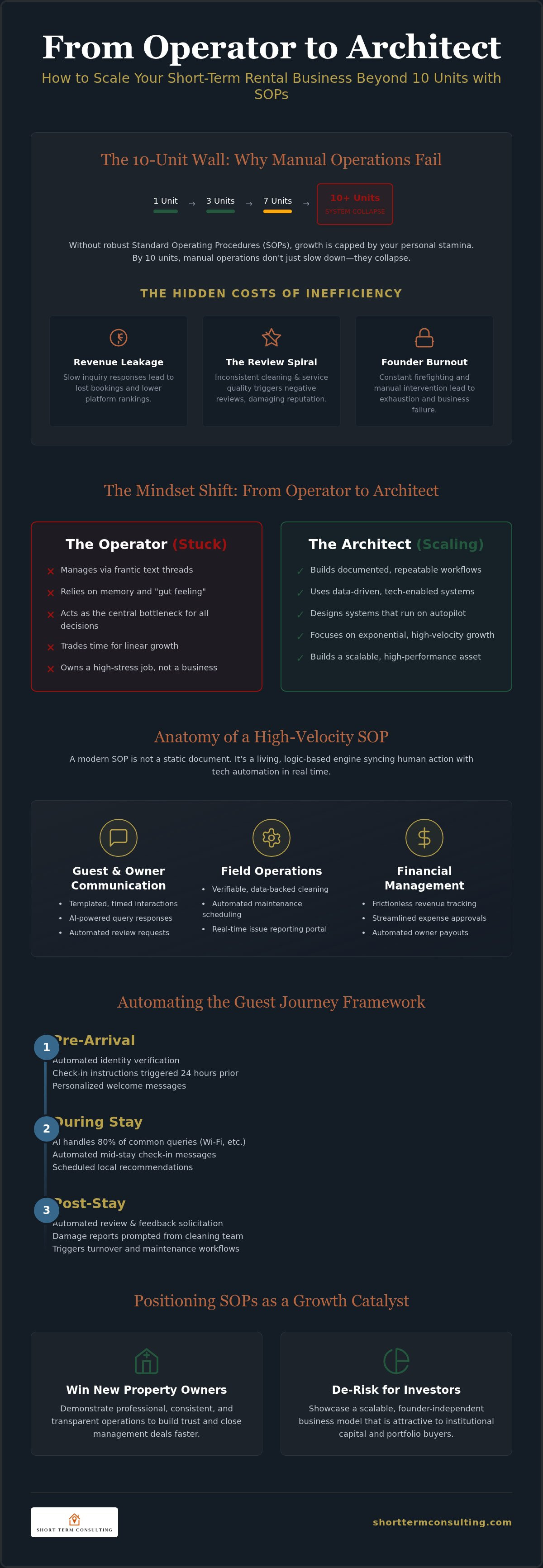
Many STR hosts start with a single property and a high-energy "hustle" mindset. They handle every guest message, every laundry load, and every maintenance call personally. This works for three units. It becomes a nightmare at seven. By the time you reach ten units, manual operations don't just slow down; they collapse. This is the "death zone" for unorganized managers. Without professional Standard Operating Procedure (SOP) frameworks, your growth is capped by your own physical stamina. Professional property management SOP development isn't a luxury. It's a survival requirement for anyone serious about portfolio expansion.
The "Founder's Friction" is the primary bottleneck. If you're the only person who knows how to troubleshoot a specific smart lock or where the extra linens are stored, you don't own a business. You've created a high-stress job. Scaling requires moving from "doing" to "architecting." If every decision must pass through you, the business cannot grow faster than your ability to answer your phone. You're trading your time for linear growth when you should be building systems for exponential scale. It's time to stop being the operator and start being the owner.
The Hidden Costs of Inefficiency
Manual guest communication is a silent revenue killer. If a booking inquiry sits for two hours while you're in a meeting, you've likely lost the lead. Slow response times lead to lower platform rankings and immediate revenue leakage. Then there's the "Negative Review Spiral." One missed cleaning detail triggers a 3-star review. These slip-ups happen when you rely on memory rather than a rigid, tech-enabled checklist. Burnout is the inevitable result. It's the primary reason STR businesses fail to reach their second year of operation. You can't out-hustle a lack of structure.
Moving from Operator to Owner
Stop thinking like a host and start thinking like an asset manager. Your "mental SOPs" are useless when it's time to hire. You can't delegate a thought process; you can only delegate a documented workflow. To scale from 1 to 10 units and beyond, your business must generate yield without demanding your presence. This requires a radical mindset shift. You're building a tech-enabled operational engine designed for high-velocity growth. Property management SOP development ensures that your expertise is codified and repeatable. The goal is simple: a business that runs on autopilot while you focus on high-level acquisition and market strategy.
Anatomy of a High-Velocity SOP: Beyond the Static Document
Stop treating your SOPs like high school essays. A static PDF sitting in a Google Drive folder is where operational efficiency goes to die. In the high-velocity STR world, an SOP is a living workflow. It's a system that syncs human action with tech automation in real time. Effective property management SOP development requires more than a checklist; it requires a logic-based engine that triggers the right action at the right moment. If your SOP doesn't tell your team exactly what to do when a guest reports a broken HVAC at 11:00 PM on a Saturday, it isn't an SOP. It's a suggestion.
Your operational architecture must rest on three pillars. First, Communication: Every guest and owner interaction must be templated and timed. Second, Field Operations: Cleaning and maintenance must be verifiable and data-backed. Third, Financial Management: Revenue tracking and expense approvals must be frictionless. Leveraging a practical framework for building SOPs allows you to design for your future portfolio size, not just your current unit count. Build for the 10% of "edge cases" that go wrong. Systemize the chaos.
The Guest Journey Framework
Control the guest experience before they even step through the door. Your pre-arrival SOP should include automated identity verification and check-in instructions triggered 24 hours before arrival. During the stay, use AI-powered response protocols to handle 80% of common queries like Wi-Fi passwords or late checkout requests. Post-stay, your system must automatically solicit reviews and prompt cleaners to report damages via a dedicated portal. This ensures consistency without your direct involvement. Refining these workflows is a core part of our property management SOP development strategies.
Field Ops and Turnover Excellence
Standardizing a "hotel-standard" clean in a residential setting is your biggest operational hurdle. You need photo-verified checklists for every turnover. Move away from "texting the handyman" for repairs. Implement a maintenance ticketing system where work orders are tracked, timed, and billed automatically. Your inventory management SOP must prevent "out-of-stock" complaints by setting automated reorder points for essentials like linens and toiletries. When your field team follows a rigid protocol, quality remains high regardless of who is on the shift. Precision is the only way to protect your 5-star rating at scale.
The Tech-SOP Synergy: Auditing Your Stack for Operational Flow
An SOP is only as good as the software that executes it. Without a robust tech stack, your workflows are just wishful thinking. In the STR space, your tech is the central nervous system. If your PMS, smart locks, and guest apps don't communicate, your team is stuck doing manual data entry. That is a waste of high-value labor. True property management SOP development requires a tech-first approach where the software enforces the protocol. If your tech doesn't drive the action, your SOP is just a dead document.
Conduct a Tech Stack Audit to identify redundant tools and data silos. A silo exists whenever data must be manually moved from one platform to another. This is where human error thrives and profit margins die. You need a "Single Source of Truth." Your SOPs must live exactly where your team works. Don't make them toggle between five browser tabs to find a protocol. If the instructions aren't embedded in the task management tool, they won't be followed. Efficiency relies on accessibility.
API integration is non-negotiable for scalability. Your smart locks must sync with your booking calendar. Your guest apps should trigger cleaning tasks automatically upon checkout. We build systems where the tech does the heavy lifting. This leaves your team to handle the high-touch exceptions rather than the routine basics. Efficiency isn't just about working faster; it's about eliminating the work entirely. When your tools talk, your business scales.
The AI Advantage in Modern SOPs
Integrate Large Language Models (LLMs) to handle instant guest communication across all OTAs. AI can answer 80% of inquiries with perfect brand voice and zero latency. Use predictive AI to flag maintenance needs before they become emergencies. Imagine knowing an HVAC unit is failing before the guest even checks in. Automating the "owner report" is another massive efficiency gain. It can save 10 or more hours of administrative work every month. This isn't future-tech. It is the current standard for elite operators who refuse to be bogged down by manual reporting.
Eliminating Tool Fatigue
Stop buying "Starter" tools for a "Scale-Ready" business. Cheap software often lacks the API depth required for true automation. Beware of the "Frankenstein Stack." This occurs when you bolt together incompatible tools, creating more manual work than you solve. Select software based on its ability to integrate and grow with your portfolio. A tech audit is the mandatory prerequisite for SOP success. Focus on lean, high-impact stacks that prioritize data flow over feature count. Your goal is a seamless operational engine, not a collection of shiny icons.
Implementing the STC Framework: From Chaos to AI-Driven Consistency
Stop guessing. Start documenting. The first step in the STC framework is the Operational Deep Dive. You must map your "As-Is" state with brutal honesty. Every manual text, every phone call, and every spreadsheet update must be recorded. This inventory reveals the friction points holding you back. From here, identify "High-Impact" tasks. These are the low-hanging fruit for immediate AI-powered automation. Focus on repetitive guest inquiries and cleaning schedules first. These areas offer the highest return on your time investment.
Build your "V1" SOP for your most critical unit turnover. This is your baseline. It must be detailed enough for a new hire to execute perfectly without calling you. Once the document is ready, move to team onboarding. Train for compliance, but encourage feedback. Your field team sees the friction you miss. Finally, enter the Iteration Loop. Refine your protocols based on real-world bottlenecks. Professional property management SOP development is a continuous process of sharpening the blade. If a system isn't evolving, it's decaying.
Building Your Operational Blueprint
Visual logic beats long-form text every time. Map your workflows using decision trees and flowcharts. If a cleaner discovers property damage, what is the exact next step? Don't leave it to chance. Assign a specific "Owner" to every task in the chain. This eliminates the "I thought he was doing it" excuse. Store these protocols in a centralized Knowledge Base that is searchable and mobile-friendly. If your team can't find the answer in 30 seconds, they'll revert to manual habits. Accessibility is the key to adoption.
Measuring Success: The KPI Connection
Data is the only validator that matters. Track SOP compliance through Guest Satisfaction Scores (GSS). If your scores dip, your systems are failing, not just your staff. Monitor "Time-to-Resolution" for maintenance and guest issues. A scalable business resolves problems in minutes; a stagnant one takes days. Use RevPAR growth as the ultimate metric for operational efficiency. When your operations are frictionless, you're free to focus on high-level yield management. If you're ready to eliminate the chaos, start your property management SOP development with a professional audit today.
Scaling Your Portfolio: SOPs as a Growth Catalyst
Professional SOPs are more than internal guides. They are your most persuasive sales tool for owner acquisition. When you pitch a high-net-worth property owner, don't talk about "great service." Talk about your operational engine. Show them the tech stack that monitors their asset 24/7. Investors and lenders prioritize de-risking. A manual business is a risky business. A systematized portfolio is a bankable asset. This is why property management SOP development is the highest-ROI activity for a growing management company.
The most successful STR brands aren't built on the backs of heroic individuals. They are built on repeatable systems. This creates a "Plug-and-Play" model. Adding unit #11 to your portfolio should involve zero operational friction. If your systems are correctly architected, the 11th property is easier to onboard than the first. You're simply plugging a new asset into an existing, high-velocity machine. Stop selling your time. Start selling your infrastructure.
The Investor Perspective
Owners want transparency. Showing them the STC Framework builds immediate trust. It proves that you aren't just "winging it." Operational transparency leads to longer-term management contracts and higher retention rates. You aren't just a manager; you're a tech-forward industry leader. This positioning allows you to command higher fees while delivering superior results. Investors don't bet on personality. They bet on the predictability of your outcomes. Professional property management SOP development provides that predictability.
Your Roadmap to Expansion
You'll know it's time to hire your first Operations Manager when your SOPs are fully documented. Their role is to oversee the system, not create it. This transition is what allows you to move from a local operator to a dominant regional player. Systematization is the only bridge to true scale. You can't be everywhere at once, but your protocols can. It's time to step out of the daily grind and into a leadership role. Ready to stop the manual grind? Audit your way to efficiency with Short Term Consulting.
Architecting Your Operational Future
Operational excellence isn't a destination; it's a competitive advantage. You've seen why manual workflows collapse under the weight of a growing portfolio. Scaling requires a shift from "doing" to "architecting." Success depends on your ability to sync human field operations with a high-velocity tech stack. By prioritizing professional property management SOP development, you're building an asset that attracts investors and de-risks your growth. You're no longer just chasing guests; you're leading a market.
Short Term Consulting brings 20+ years of hands-on operator experience to your business. We are specialists in AI-powered scaling, offering tailored frameworks that turn operational friction into momentum. Don't let your current success become your future bottleneck. Build the engine that allows you to manage 10 or more units with total precision. It's time to reclaim your time and focus on high-level acquisition.
Book an STR Operations Audit & SOP Strategy Session
Your business is ready for the next level. Let's build the systems that take you there.
Operational Excellence: Frequently Asked Questions
What is the first SOP every short-term rental manager should create?
The turnover and cleaning protocol is the first SOP every manager must document. This process occurs most frequently and has the highest impact on guest reviews. A failed clean leads to immediate negative feedback and potential refund requests. Your turnover SOP must include photo-verified checklists, linen inventory counts, and specific maintenance checks. Codifying this first secures your reputation while you build out more complex guest communication or financial systems.
How often should I update my property management SOPs?
You should review and update your protocols at least once per quarter. The STR industry moves fast; platform algorithms and local regulations change frequently. For instance, new Clark County licensing rules in 2026 or Salt Lake City's zoning updates require immediate adjustments to your compliance workflows. Additionally, every time you add a new tool to your tech stack, your SOPs must reflect the updated data flow to remain functional.
Do I need expensive software to implement a property management SOP?
Professional property management SOP development doesn't require the most expensive software, but it does require integrated tools. You can start with basic project management apps or shared drives. However, as you scale toward 10 units, you'll need a PMS that supports automated triggers. The cost of manual labor always exceeds the cost of a well-chosen software subscription. Focus on tools that offer deep API access rather than high price points.
Can AI really handle guest communication without losing the human touch?
AI can handle roughly 80% of routine guest inquiries without sacrificing quality. Modern LLMs are trained to mirror your specific brand voice and respond to queries about Wi-Fi or check-in instructions instantly. This speed actually improves the guest experience. By automating the repetitive basics, your team stays fresh and available to handle the 20% of complex, high-emotion situations that truly require a human touch and personalized problem-solving.
What is the difference between an SOP and a simple checklist?
A checklist is a simple list of tasks; an SOP is the comprehensive framework that explains the logic, timing, and ownership of those tasks. While a checklist tells a cleaner to wipe the counters, an SOP defines the specific disinfectant to use, the expected standard of cleanliness, and what to do if the counter is damaged. SOPs are strategic operational engines, whereas checklists are just tactical memory aids for field staff.
How do I ensure my cleaning team actually follows the SOPs?
Ensure compliance by requiring photo verification for every critical task. Modern field ops software allows cleaners to upload time-stamped images of the staged property before they can mark a job as complete. Pair this with random, unannounced quality audits and a performance-based incentive structure. When your team knows their work is being tracked and verified against a documented standard, the likelihood of operational slip-ups drops significantly.
What are the most common reasons property management SOPs fail?
Most SOPs fail because they are treated as static documents rather than living workflows. If instructions are buried in a PDF that nobody reads, they won't be followed. Failure also stems from a lack of clear ownership or tool fatigue, where the tech stack is too fragmented to support the protocol. Without a single source of truth where the team actually works, even the best property management SOP development plans will gather digital dust.
Is it better to buy an SOP template or build one from scratch?
Avoid generic, one-size-fits-all templates. They rarely account for your specific market, tech stack, or team structure. While templates can provide a basic outline, the most successful operators build tailored frameworks that reflect their unique operational DNA. Starting from a battle-tested framework like the STC model is more efficient than starting from scratch, but the final SOP must be customized to your specific portfolio to be truly scalable.